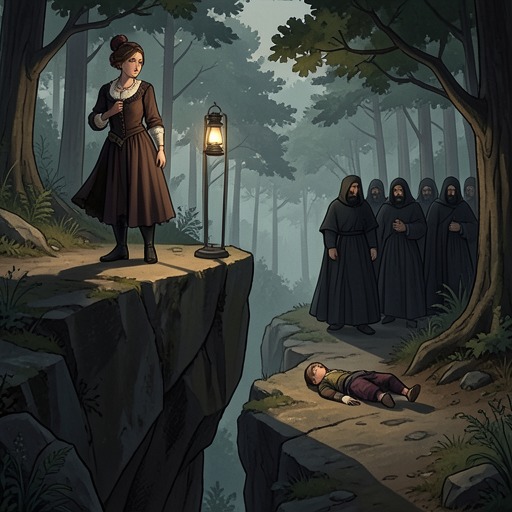
Good for today, better tomorrow
The Ballad of the Last Dragon“Good for today, better tomorrow” is a principle of provisional hope articulated by Neith and adopted by Sylvaine Abelan. It does not promise that pain will disappear or that progress will be easy; instead, it treats survival, effort, and moral persistence as sufficient achievements for the present while preserving the possibility of change. In the surrounding conversation, the expression becomes the phrase that converts disappointment into forward motion.
Definition and Immediate Context
Neith introduces the idea while explaining the cost of choosing an independent life. She describes having given up everything to follow her own path, burning bridges and being disowned by her family because she refused to become merely a transaction. Her position is therefore not comfortable freedom but an unfinished, difficult search: she has not yet found the path she is meant to walk, yet she will continue searching, trying, and fighting. Against that background, “good for today, better tomorrow” rejects the demand to possess a complete answer immediately.
The phrase carries a deliberate contrast between acceptance and ambition. “Good for today” acknowledges the limits of the present without turning them into a final judgment. “Better tomorrow” keeps the future open and makes improvement an active direction rather than a passive wish. Neith does not describe inadequacy as a permanent identity; she frames the current condition as one stage in a continuing attempt to discover what the self can become.
Sylvaine’s Adoption of the Principle
Sylvaine receives Neith’s words at a point of acute emotional and physical depletion. She is thinking of Jaromir and of the belonging she believed she had with him and the others, only to conclude that such belonging may no longer matter. Neith’s account of exile and self-determination gives Sylvaine a language for her own dislocation: the loss of a former place does not necessarily mean the loss of every possible future place.
Sylvaine then applies the expression directly to herself. For the present, she is a luteless bard with a broken heart and weak arms. That inventory is stark rather than falsely reassuring; the phrase does not erase the broken instrument, the grief, or the bodily weakness. Its force lies in the next step. Tomorrow she will still carry those wounds, but she will also be closer to completing Aeron Fowler’s tale, to entering the next chapter of her own story, and, with the favor of Welkin’s guardians and the goddess, to reaching an ending she can deserve.
This repetition changes the expression from advice into a vow. Neith speaks it as a general rule for a life not yet resolved, while Sylvaine turns it into a narrative commitment. Her future is measured not by sudden restoration but by movement toward the end of Aeron Fowler’s story and toward authorship of her own. The phrase thus links artistic labor with personal recovery: continuing the tale is one of the concrete ways Sylvaine continues herself.
Endurance, Relapse, and Moral Choice
The expression is not presented as uncomplicated optimism. Sylvaine recognizes that the new focus may be fleeting and that the next day may again bring a crushing sense of weight. The important promise is not that hope will remain permanently available, but that she will search for it again and drag herself toward the possibility of a better day. “Better tomorrow” therefore includes recurrence: hope may have to be recovered repeatedly rather than possessed once and for all.
Neith strengthens this interpretation by challenging Sylvaine’s understanding of mercy. Sylvaine has treated her decision to stay her hand as evidence of weakness, but Neith calls the choice a form of strength. Finding mercy in the face of anger is difficult, and the softness that permits restraint is presented as something the world needs rather than something Sylvaine should be ashamed of. The expression consequently governs more than physical recovery or artistic continuation; it describes a moral practice in which a person refuses to let injury dictate the kind of person she will become.
Sylvaine’s memory of holding her sword above Donnick clarifies the principle’s ethical center. She cannot find regret in refusing to deliver the final blow, even though she feels shame when imagining what others may think. She would lower the sword again and again. The act was neither simple survival nor an automatic response at the edge of death, but a choice made when she had the opportunity to decide who she wanted to be going forward. “Good for today, better tomorrow” therefore honors incomplete progress while insisting that each present choice helps shape the future self.
Narrative and Thematic Significance
As an expression, the phrase condenses the book’s larger movement from rupture toward continuation. Sylvaine’s broken heart, weak arms, and lost lute represent a present marked by deprivation, while the promised “tomorrow” is not an abstract reward but the next chapter of a story she must still perform, carry, and complete. The wording’s modest scale is crucial: it replaces grand recovery with a survivable standard, allowing determination to exist without denying damage.
The phrase also establishes a bond between Neith and Sylvaine. Neith’s history of family rejection and unfinished searching gives the counsel personal authority, while Sylvaine’s adoption of it shows that the words have produced an immediate change in her orientation. She moves from believing that her losses have made the present meaningless toward treating the present as enough to continue from. Neith’s later affirmation that Sylvaine is a fighter confirms the shift: mercy, persistence, and the refusal to surrender are recast as strengths.
“Good for today, better tomorrow” ultimately defines hope as disciplined continuation rather than certainty. It allows grief to remain visible, admits that renewed focus may fail, and still demands another attempt. Within Sylvaine’s recovery and her continuation of Aeron Fowler’s tale, the expression becomes a small but durable form of resistance: the present need only be endured honestly, because the next day remains available for making it better.